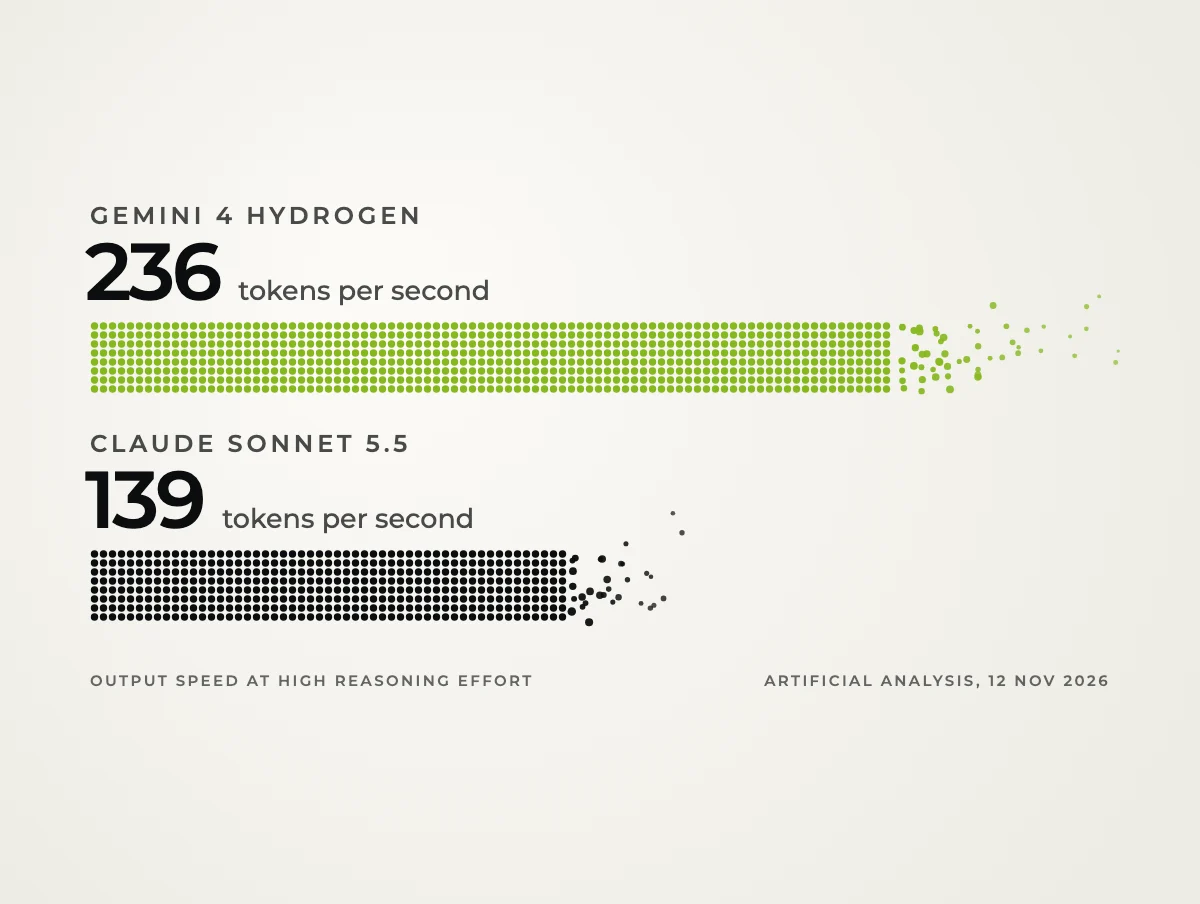
Google released Gemini 4 Hydrogen on 12 November 2026. Hydrogen is the lightest element, and the name fits: this is the quick, inexpensive member of the Gemini 4 family, built for the work that fills most days. Three days after Claude Fable 5.2 raised the ceiling of what a model can do, Hydrogen moves a different limit: how long you wait.
What Hydrogen is
Google calls it its daily driver for agentic workflows: a model built for rapid execution, while Gemini 4 Carbon and Argon keep the deep, long-horizon reasoning. It succeeds Gemini 3.8 Flash, reads up to a million tokens in one go and has four thinking levels, from low to a new xhigh, with high as the default.
It costs $1.50 per million input tokens and $7.50 per million output tokens, a quarter less than Claude Sonnet 5.5. It is in Google Search, in the Gemini app, where free users get it when the app judges that a prompt needs it, and in the Gemini API for developers.
How fast it writes
The simplest measure of speed is how many tokens a model produces per second. Artificial Analysis, which measures each model on its maker’s own service, clocked Hydrogen at 236 tokens per second at its default setting. Claude Sonnet 5.5 produces 139. That is about 70% more text in the same second.
- Claude Haiku 5.5 (max)256
- Gemini 4 Hydrogen (high)236
- Claude Sonnet 5.5 (high)139
- Claude Opus 5.5 (max)115
- Gemini 3.8 Flash (high)111
- Claude Fable 5.2 (max)98
- Gemini 4 Carbon (high)76
- GPT-6.1 Sol (max)51
Source: Artificial Analysis, read on 12 November 2026. The reasoning setting of each model is in brackets.
Across its four settings Hydrogen runs between 177 and 236 tokens per second, and Sonnet 5.5 between 136 and 144. Claude Haiku 5.5, a smaller model, is faster still.
How fast it finishes
Tokens per second is the speedometer. What you feel is the journey: how long until the task is done. Artificial Analysis also times each model on the tasks of its Intelligence Index, and this is where Hydrogen separates itself.
At its default setting Hydrogen scores 51 on that index and takes 6.0 minutes per task. Sonnet 5.5 needs its xhigh setting to score 50, and takes 14.6 minutes. At the top, Hydrogen reaches 54 in 13.0 minutes, where Sonnet 5.5 reaches 55 in 33.0. Give both about the same time, six or seven minutes, and Hydrogen scores 51 to Sonnet’s 42.
- Gemini 4 Hydrogen, high (51)6.0 min
- Claude Sonnet 5.5, xhigh (50)14.6 min
- Gemini 4 Argon, high (50)30.2 min
- Gemini 4 Hydrogen, xhigh (54)13.0 min
- GPT-6.1 Sol, max (55)22.1 min
- Claude Sonnet 5.5, max (55)33.0 min
Source: Artificial Analysis Intelligence Index, read on 12 November 2026.
A similar level of answer in about 40% of the time. It is cheaper too: at the top settings a task costs $3.16 with Hydrogen and $10.02 with Sonnet 5.5. Google’s own claim is that Hydrogen finishes tasks 2.5 times faster than Gemini 3.8 Flash, and the independent numbers agree: 6.0 minutes against 14.8, with the index rising from 31 to 51.
Where the speed stops
Fast to finish is not fast to start. Hydrogen thinks before it answers: about 15 seconds to the first word at its default setting and 41 at xhigh. At their lowest settings, Sonnet 5.5 starts in under 3 seconds and Hydrogen in about 6.
Live traffic disagrees, for now. On OpenRouter’s launch-day medians, Sonnet 5.5 was ahead on both throughput and latency. Launch days are busy, and the picture needs a week.
Speed is not skill. In Google’s own launch table, Sonnet 5.5 still leads on terminal coding, 63.9% to 57.0% on Terminal-Bench 4.1, and on computer use, 83.9% to 77.6% on OSWorld-2.1.
Tokens per second can mislead. Haiku 5.5 is the fastest writer in the chart above, and still takes 14.7 minutes per task, for a score of 36.
These are first-day measurements. Speed depends on load, and the numbers will move.
What speed changes
Speed is not a comfort. It changes what you attempt. When an answer takes half an hour, you ask once and accept what comes back. When it takes six minutes, you ask again, compare and choose. Judgment is formed in that second and third attempt, and a fast model is what makes them affordable.
For agents the effect compounds. An agent plans, acts and checks in a loop of hundreds of steps, and every second saved is saved hundreds of times. A run that took the whole working day can end before lunch, while the person who asked for it still remembers why.
And for a studio that builds robots and connected devices, speed is not a detail of the experience. It is the difference between a machine that responds and one that hesitates.
Fable 5.2 showed how much a model can do. Hydrogen shows how little we may have to wait for most of it. Intelligence decides what is possible; speed decides what becomes a habit. The work that changes first is the work we finally stop postponing.
We will time it ourselves in the Lab and report what holds.
Speed, score and cost figures are from Artificial Analysis. Launch claims are from Google’s announcement and from coverage of its benchmark table. Live-traffic figures are from OpenRouter. All were read on 12 November 2026. This article was drafted with Claude Fable 5.2 and reviewed by Pixelgrammar.